Cactus Light Requirements: How Much Sun Does a Cactus Need?
Find out what direct sun, bright indirect light and low light really mean, how to judge your own windows, and how to tell when a cactus is getting too little or too much.

Light is the one thing you cannot make up for with better soil or more careful watering. A cactus that receives too little of it slowly changes shape, and the change does not reverse. So it is worth understanding cactus light requirements before you decide where a plant will live.
The short version: most desert cacti want the brightest position you can offer, with some hours of direct sun, while forest cacti prefer bright light that is filtered. The longer version is about working out what your own windows really provide, because rooms that look bright to people are often dim to a plant.
Direct sun, bright indirect light and low light
These three terms appear in almost every care guide, so it helps to pin them down.
- Direct sun means the sun’s rays land on the plant itself. If you could see the sun from where the plant sits, it is in direct sun.
- Bright indirect light means a well-lit position that the sun’s rays do not reach, or reach only through a sheer curtain: beside a sunny window but out of the beam, for example.
- Low light is a place where you could read comfortably but where objects cast little or no shadow, such as the far side of a room or a shelf in a hallway.
Eyes adjust to dim conditions so well that they are poor judges of brightness. A spot a few steps back from the glass can receive only a small fraction of the light on the windowsill.
What changes how much light a window gives
Four things decide what actually reaches the plant. The directions below assume the Northern Hemisphere.
- Window direction. South-facing windows usually receive the most sun through the day. West-facing windows get strong afternoon sun, east-facing windows get gentler morning sun, and north-facing windows get little or no direct sun.
- Distance from the glass. Light falls away quickly as you move into the room. The sill and the first foot or two (30 to 60 cm) beside it are a different world from the middle of the floor.
- Obstructions. Trees, neighboring buildings, roof overhangs, insect screens, blinds and dusty glass all take a share.
- Season. Winter days are shorter and the sun is weaker and lower in the sky. A window that is ideal in June may be only adequate in December.

The hand-shadow test
For a rough check that needs no equipment, try this around the middle of a clear day:
- Hold your hand about a foot (30 cm) above the place where the plant would sit.
- Look at the shadow it casts on the surface.
- A dark shadow with crisp edges suggests direct sun or very strong light. A softer shadow that is still clearly a hand suggests bright indirect light. A faint, blurry shadow, or none, suggests low light.
Repeat it in the morning and afternoon, and again in another season, since the answer changes through the day and year.
Desert cacti and forest cacti want different light
Barrels, columns, pincushions and prickly pears come from open, sunny habitats. Clemson Cooperative Extension’s indoor cacti factsheet advises bright sunlight for desert cacti, such as a south- or west-facing window, and bright but filtered light for rain forest cacti.
That second group includes the Christmas, Thanksgiving and Easter cacti. They grow under a forest canopy in nature, and strong midday sun through glass can redden or scorch their flat segments. An east-facing window, or a brighter window softened by a sheer curtain, tends to suit them.
Needs also differ among desert species. Densely spined or woolly kinds are generally adapted to intense sun, while some green, lightly spined globes are content with a little less. When you know the name of your plant, look up that species.
Signs of too little light
A desert cactus short of light often shows it in new growth first:
- the top grows narrower than the body below it, so a globe turns pear-shaped or a column tapers;
- new growth is a paler, yellowish green;
- new spines are smaller, thinner or more widely spaced;
- the whole plant leans toward the window.
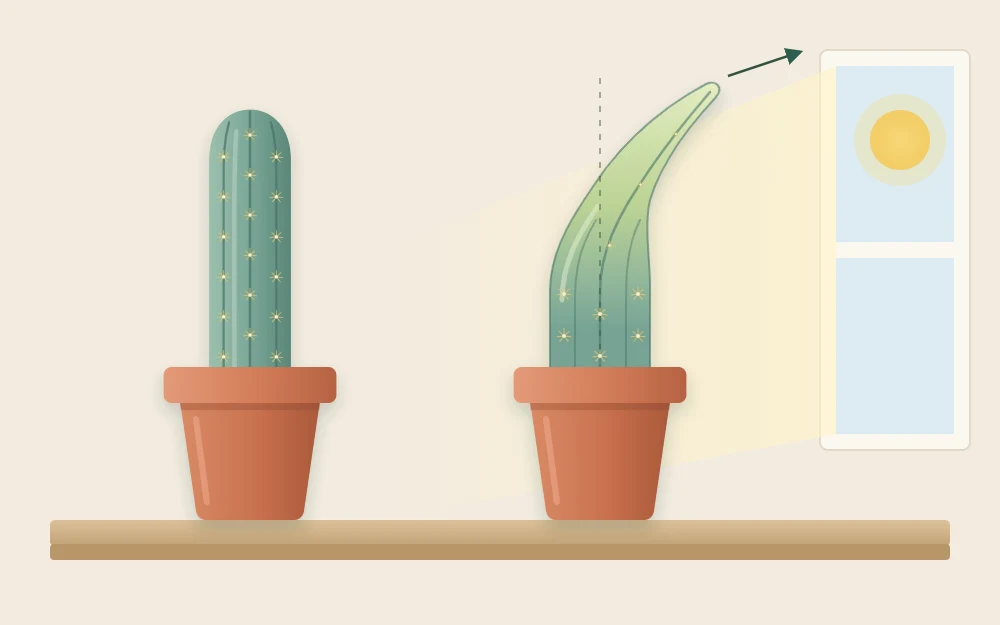
This stretching is called etiolation. Leaning on its own can also come from an unstable root ball or uneven growth, so look at the shape and color of the newest growth as well. The guide to why cacti stretch and what you can do covers the options, including the fact that stretched tissue does not fill out again.
Signs of too much light, too fast
Even a sun-loving cactus can burn. The usual cause is not the amount of sun but the speed of the change: a plant raised under shade, or kept in a dim room, is moved straight into hours of strong direct sun.
Scorch commonly appears as bleached, yellow-white or tan patches on the side facing the light. Those patches are permanent, though the plant can carry on growing around them. Some species also turn reddish or purplish in strong light, which is a stress color and is often reversible.
Good to know
Glass does not prevent sunburn, and a closed sunny window can become very hot in summer. Increase exposure in stages over a couple of weeks or more. See how to move a cactus into brighter light without sunburn for a gradual plan.
Choosing and adjusting a spot
Start with the brightest window you have and place desert cacti as close to the glass as is practical. Turn the pot a quarter turn now and then so that growth stays even, holding the pot, not the plant.
Then watch the new growth over the following months. Compact growth with strong spines and good color means the spot is working. Thin, pale growth means the plant needs more: a brighter window, a position nearer the glass, or a plant lamp in a home with no sunny windows.
For a room-by-room look at sills, shelves and desks, see where to put a cactus indoors. For general background on window light, see University of Maryland Extension’s guide to lighting for indoor plants.
Frequently asked questions
Can a cactus live in a room without direct sun?
Forest cacti such as Christmas cactus generally do well in bright filtered light. Most desert cacti survive for a while without direct sun but tend to stretch and pale over time. In a home with no sunny window, a plant lamp placed close above the plant is the usual way to make up the difference.
Is a north-facing window enough for a cactus?
In the Northern Hemisphere a north-facing window gives little or no direct sun, which is usually too dim for desert cacti over the long term. It may suit a forest cactus if the window is large and unobstructed. Watch the new growth: thin, pale growth tells you the plant needs more light.
Why does a cactus get pale patches after a move to a sunnier spot?
Bleached or tan patches on the side facing the light are commonly associated with sunburn after a sudden increase in exposure. The marks are permanent, but new growth can be normal. Move the plant back to gentler light and raise the exposure in stages over a couple of weeks or more.

